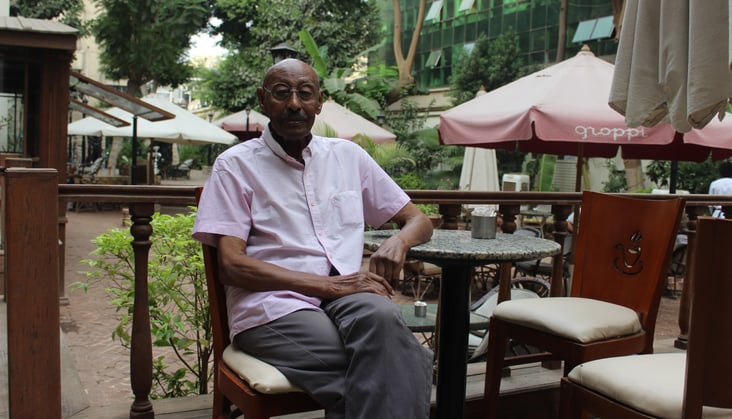
Fleeing from war-torn Sudan, veteran director-screenwriter Ibrahim Shaddad speaks his lifetime of art amid strife. (The Africa Report)
“It took us five days to reach Cairo from Khartoum, a distance that usually takes only a few hours,” says Ibrahim Shaddad, a renowned Sudanese film director, sipping his tea in Groppi, an iconic coffee shop in Cairo’s Downtown.
“In Khartoum, my home was surrounded by gunshots, with no electricity, food and water. We moved to my brother who lives in a calmer area, hoping to return home after a few days. We never did, says Shaddad.
He came to Cairo in June with his wife and the clothes on their backs.
“We left behind everything and all memories,” he muses.
Lifeline of stories
Shaddad’s passion for cinema and storytelling shows immediately comes through as he starts recalling the distant past when his young mind was filled with dreams.
One of the foremost filmmakers of his generation in Sudan, Shaddad has given his home country countless contributions to its cinema development. One of the core members of Sudan’s short-lived cinematic era in the 1960s-1980s and against all odds, he continued contributing to the world of cinema throughout the decades.
“I thought of studying law in India. You know, Sudanese law is in big part derived from the Indian one. I ended up enrolling at the faculty of agriculture in Germany,” he laughs, enjoying building a bit of suspense before embarking on the topic of filmmaking.
“I did not stay in agriculture for long though. Instead, I started studying film production at the Filmuniversität Babelsberg Konrad Wolf [then Academy for Film and Television of East Germany] graduating in 1964,” he says.
READ MORE Coup risks: Burkina Faso, Libya, Mali, Somalia, Sudan top of league
Inspired by the changes taking place in his own country, as well as Egypt, Algeria, Senegal, Cuba and India, he felt closer to “the world that has been changing. This was my youth, we all believed that real cinema comes from those countries”.
But his topics of choice would become troublesome for the consecutive governments of Sudan.
His first film, a 41-minute black-and-white existentialist work Jagdpartie (Hunting Party, 1964), a graduation project from the academy in Germany, proved problematic for the government.
The film focuses on the issue of racism, by portraying a “white mob’s hunt for a black farmworker,” the synopsis reads.
Movies with a message
Shaddad’s generation was mainly educated in Europe, returning to their country with the hope of forming a cinematic movement.
“In 1957, we founded the Sudanese Film Club. We organised screenings, workshops, looked for ways to support films’ production,” he says, referring to the early 1960s up to the 1980s, years which saw intense film work – the most prominent titles being documentaries, short and medium-length narratives – all characterised by a unique cinematic aesthetic.
The group organised international film screenings, including one or two from Sudan, which grew as they continued to shape cinematic awareness in the country.
“We did not do cinema for money, but out of sheer passion and a belief in how it affects communities. We wanted the Sudanese people not only to discover their country’s cinema but also to be affected by its messages,” he says.
Those years saw Shaddad’s Jamal (The Camel, 1981), a short film about a camel, a character that operates a sesame mill, with an idea of drawing parallels with the human condition. The film scored the critics’ prize at the Cannes Film Festival (1986). Another film, The Rope (Al-Habil, 1985) brought him a golden prize at the Damascus Festival (1987).
The club created a catalogue of films, such as But the Earth is Spinning (1979) by Suliman Elnour, The Mausoleum (1976) and Four Times for Children (1979) by Eltayeb Mahdi among others.
Additionally, Shaddad, Elnour, Mahdi and Manar Al-Hilo are protagonists of Suhaib Gasmelbari’s Talking About Trees (2019), a multi-award-winning film that pays tribute to the Sudanese Film Club.
Banned by the government
This dynamism led to the formation of The Sudanese Film Group in 1988, producing more than 40 films. The group was formed with a plan to act more independently from the state.
This development was short-lived as the military coup of 1989 introduced an Islamic government, bringing an end to the cinema and a large part of cultural life.
“The whole production came to a halt. Cinemas closed. We could neither screen films, nor produce new ones,” says Shaddad.
Shaddad’s journey in the film industry was filled with countless obstacles.
“So many of my works were banned by the consecutive Sudanese governments: 10 films, a number of theatre and television plays,” says the accomplished screenwriter and theatre director, adding that a few were stopped during production.
He talks about “a curse” that continued in the following decades in a very calm manner – he has gotten used to the hardships, but has not allowed them to defeat him.
With no recognition from Sudan, Shaddad’s films were screened and awarded at international festivals. His short Insan (Human Being, 1994) – a turbulent story without dialogue about a villager from South Sudan who feels alienated in a large city – was screened around the world.
Despite the emergence of digital film tools and with the ban on cinema no longer in place, economic hardships continued to debilitate the field.
“Of course we did not stop making films, but they come with many production burdens,” he notes.
Exile, again
Living outside his home country is not new for Shaddad. He spent years in exile in Egypt and Canada before returning to Khartoum. Now in a new exile in Cairo, he recalls the recent decade and activities headquartered in the Omdurman Cultural Centre, on the west bank of the River Nile, opposite Khartoum.
“In Omdurman, we did workshops in directing, editing; provided cameras and computers. We engaged with the communities, discussed their problems, and looked at the ways of transferring them into films,” he says.
Working themes included touching on social and political issues as well as conflicts embedded in traditions and religions. The centre extended its activities to other Sudanese governorates, trying to sway ways of thinking.
The Mobile Cinema for Social Change became a popular project that responded to the growing number of movie aficionados outside the capital.
“We did more than 150 performances, we had projects in the pipeline … It was all frozen by war, destroyed,” he says, noting that the centre and its contents were destroyed during the recent military actions.
“Films, hard disks, books, pages of scripts. Everything was either destroyed or stolen … I don’t know if anything can be recovered,” he notes, wistfully.
Powering on
Some of the material representing his most important life work and that of his colleagues were restored by Arsenal, a film and video institute based in Berlin; some works are in other archives. Shaddad has also tried to recover “works that were shared with friends, in emails here and there”.
Unfortunately, the destiny of Shaddad’s most recent work is more sinister.
“It’s the final part of the trilogy that I am most worried about. The trilogy includes The Actress, The Rat and The Professor – all tackling a theme of torture,” he says.
“The first two parts did not perish but the fully developed script of The Professor was left behind in Omdurman” says Shaddad, adding that he is speaking to industry colleagues to see if he has shared the script with them so that he can continue working on it.
“We are the filmmakers of the Sudanese Cinema Club; we went through many tribulations, gathered a large count of members; we made many films,” he says, stressing the perseverance of the group, which still has an active schedule.
Nothing like Sudan
Once assurance within Sudan is restored – young filmmakers will be able to go back and practice their craft, he says.
“We must have Sudanese cinema. To do this one needs to be embedded in Sudanese culture; live and breathe the country,” he says.
“In a country troubled by endless conflict and wars, cinema may seem to be a needless luxury. Cinema is entertainment indeed, but it is also an important tool for raising awareness,” he says, drinking his last drop of tea.

 Ati Metwaly