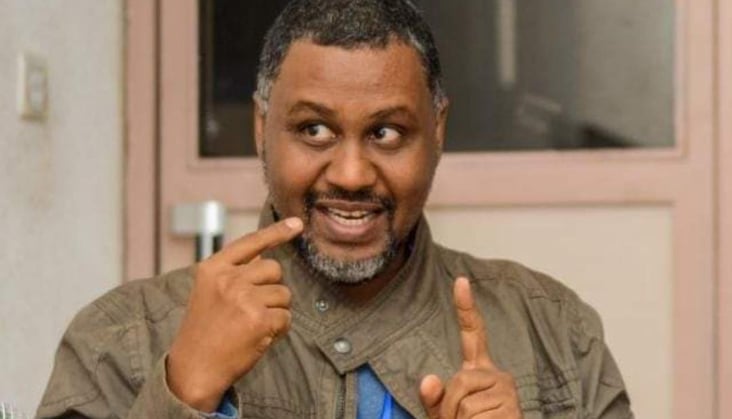
Director/producer Mohammed Altraifi wants to focus on distribution of stories made by Sudanese filmmakers to reach everyone.
Published in The Africa Report
“The Sudanese cinema is alive, growing outside its home country, finding international recognition,” Sudanese director and producer Mohammed Altraifi tells The Africa Report in Cairo, where he has re-established his company Marble Art Production.
“Since the wave of protests of 2018-2019 in Sudan, the world is asking about us. Since the eruption of war in April 2023, the opportunities have multiplied. The world is attracted to tragedies; people want to hear Sudanese voices. In a way, the humanitarian element drives the industry forward,” he adds.
Many Sudanese lost their homes, and thousands have gone into exile, all while the world has been watching. For Altraifi this exposure is also a responsibility.
Back in Sudan, the Marble Art Production worked across all spectrums of cinematic production. “I want to focus on the distribution of the stories made by Sudanese filmmakers to reach everyone. The new collaborations will create opportunities for more stories to emerge.”
Mobile cinemas once roamed Sudan’s countryside
In recent years, many international festivals have shone a light on Sudanese cinema, showcasing the history of the country’s seventh art, and honouring its creators.
Altraifi reminisces on the decades of Sudan’s short-lived golden cinematic era (1960s-1980s), which included the Sudanese Film Club, Ibrahim Shaddad, Suliman Elnour, Eltayeb Mahdi, among others.
At its peak, national movie theatres celebrated masterpieces from Bollywood to Hollywood, the mobile cinemas roamed Sudan’s countryside. He points to the years of fascinating connections and experiments, remembered by the elders of the field.
When Sudan was hit by the Islamist-backed coup in 1989 bringing President Omar Al-Bashir to power, two decades of artistic drought began, thereby suppressing all cultural activities.
The cinema institutions were dissolved, and workers were laid off. “Very few works were presented in television or cultural centres – they were fully controlled by the regime,” Altraifi says, noting the exceptions that had been authorised by the government, such as films by Abdel Rhaman Mohammad Abdel Rahman, Egypt-educated Sudanese director.
“The cultural stagnation extended to all art fields. A few operational theatres presented plays that supported the regime’s agenda. Television dramas were no different. The lack of funds, the internationally imposed embargoes and sanctions, solidified the status quo,” he adds.
“A few filmmakers were trying to resuscitate the industry,” Altraifi says, pointing to Saeed Hamed, a Sudanese filmmaker whose career flourished in Egypt, his adoptive home. A strong advocate of cinematic cooperation not only between Egypt and Sudan but also between Egypt and African countries, Hamed obtained the honorary Egyptian permanent residency in 2017.
In the 1990s and the early 2000s, Altraifi watched Sudan from the UAE where he launched his work in cinema directing, production and scriptwriting. In 2009, at the peak of cultural restrictions, he made what back then seemed an unprecedented move.
Sudan’s cinematic awakenings
“I decided to return to Sudan! No one could understand my decision since at that time I could work better outside my home country,” he explains.
Luckily for Altraifi, the 2010s proved promising for budding filmmakers: the Sudan Film Factory opened in 2013, and the Sudan Independent Film Festival launched a year later. This slight movement was paralleled with filmmakers working for corporate and commercial entities, engaging in the production of TV programmes and series, music videos, etc.
“I founded the Marbles Art Production to earn a living by creating films for companies, cooperating with UNICEF, and producing sitcoms.”
By the mid-2010s, the consecutive waves of protests in the country coupled with Bashir’s faltering maneuvres of the national dialogue led to the Islamists losing grasp on the country. “They could no longer control the people. The cinema started forging its ways through the administrative havoc and new faces of corruption,” Altraifi says, noting that his 2015 film Place in the Soul (Makan Fel Rouh), a Sudanese production, screened commercially in Afra (Star) Cinema, in Khartoum. The movie theatre was located inside Afra Mall, a shopping centre providing a variety of entertainment to families of Khartoum.

Then came the 2018 revolution which felt like “a breath of fresh air,” he says, pointing to a growing hope. “The entire environment began shifting, in culture, business, etc,” Altraifi explains, giving examples of a few important Sudanese movie productions supported by Egyptian and international producers.
- Akasha by Hajooj Kuka premiered at the Venice Film Festival (2018)
- Suhaib Gasmelbari’s documentary Talking About Trees (2019) is an ode to Sudan’s old cinema
- You Will Die at Twenty (2019) by Amjad Abu Alala, was Sudan’s first-ever submission to the Best International Feature Film at the 93rd Academy Awards (2020)
- Khartoum Offside (2019) by Marwa Zein premiered at the 2019 Berlinale Forum
- Al-Sit (2021), a short film directed by Suzannah Mirghani and echoed internationally
- Mohamed Kordofani’s Goodbye Julia, which premiered in Cannes in 2023, was in the making when the civil war broke
Breaks on culture and democracy
Altraifi then turned to the military coup of 25 October 2021 that put a break on the democratic transition and culture.
“Under army chief Abdel Fattah Al-Burhan’s council there were no clear laws, and cultural activities were of no priority. We ended up shooting segments of Love Hymn (Tarneemat Hob) in secrecy,” Altraifi says. Unable to be screened in Sudan, the series premiered in 2022 on Shahid, an Arabic VOD service operated by MBC.
“This political background challenged Kordofani’s shooting of Goodbye Julia.”
Back on the outside
Altraifi left Khartoum after the eruption of war on 15 April 2023. “I vividly remember the destroyed offices of Marbles Art. I was risking my life just to get there and take my passport,” he says.
In December 2023, more than half a year into the war in Sudan, Altraifi posted a photo of Afra Cinema destroyed by the Sudanese militia. The caption reads: “Before Ramadan [before April 2023], we had just completed our agreement for the distribution of the film You Will Die at Twenty, and we had deals finalised with movie theatres in Khartoum. Meanwhile, Goodbye Julia was in the final days of production. We were filled with enthusiasm…”
“The movie theatre is destroyed, so is Khartoum, but our work continues. People want to create; audiences are interested in watching. Some Sudanese filmmakers have gone on to create new channels from outside the country, Shofna, Forja, Habka, among others,” he says while he moves on to the many obligations that the Cairo-based Marbles Art Production has on its plate.

 Ati Metwaly