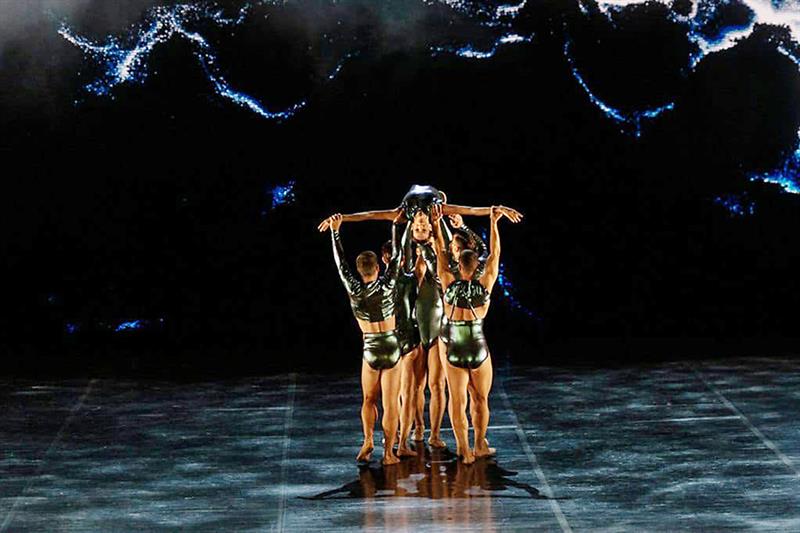
On 6 and 7 June, the Greek National Opera (GNO) Ballet gave two performances at the main hall of the Cairo Opera House, taking us to the world of many sensations wrapped in kinetic beauty
Published in Al Ahram Weekly & Ahram Online
The performances included Dancing With My Own Shadow (6 June) directed and choreographed by Konstantinos Rigos to music by Manos Hadjidakis; and Return of the Summer (7 June), a modern dance diptych that includes Point of No Return, choreographed by Ioannis Mandafounis to music by Giorgos Koumendakis and Les Nuits d’Eté, choreographed by Rigos to Hector Berlioz’s song cycle.
Hadjidakis (1925-1994), the grand poet of Greek music as he is known, is frequently performed by the Greek National Opera. In 2018, the Opera launched the Manos Hadjidakis Cycle, its name derived from the composer’s C.N.S. Cycle, aiming to “give the audience the opportunity to revisit some of his famous compositions, as well as some obscure gems from his rich body of work,” according to the opera’s web site.
Coming to Egypt with Dancing With My Own Shadow, the GNO Ballet celebrates the composer’s 30th death anniversary. Choreographed by Rigos, the work premiered with GNO dancers at the Stavros Niarchos Hall in 2019. The Cairo audience were treated to The C.N.S. Cycle, Captain Michalis, and The Accursed Serpent. Rigos’s original cycle also includes the Gioconda’s Smile, completing some of the most iconic works by Hadjidakis.

I was sadly unable to attend the 6 June performance, so I can only talk about the two parts of Return of the Summer.
Point of No Return is a ballet deeply submerged in classical dance forms. A well respected choreographer of his generation, and a graduate of the Conservatoire National Supérieure de Musique et de Danse de Paris, Ioannis Mandafounis is also influenced by traditional dance forms.
It is through hints of Greek culture supported by the music of Giorgos Koumendakis that the viewer is offered an Ionian vessel of classical purity. While the choreography is an obvious child of the classical ballet, this new offspring does not negate the time, history and geography of Greek folklore.

Greece is definitely more apparent in the music, a piece composed by Koumendakis for a string quartet as a loose interpretation of the anonymous folk song. Coming to our ears as recorded music, the soul of the composition needed live musicians to give justice to its captivating flavour, bringing to light all the melodic turns hidden within its vibrantly changing rhythms.
The marriage between classical dance and Greek heritage continued through Les Nuits d’Eté choreographed by Rigos. Here the union relied on kinetic juxtapositions with respect to fluidity. In other words, the presence of the classical ballet was extremely apparent with Greek components remaining strikingly obvious in the underlying concepts, choreography, and group images.
Les Nuits d’Eté (Summer Nights) is a song cycle by the French composer Hector Berlioz, written originally for soloist (mezzo-soprano or tenor) and piano accompaniment, and completed in 1841. Though the composition was then orchestrated, it did not receive the recognition it deserved until the 20th century when it began being performed within the recital featuring renowned singers or with the orchestras.

Set to six poems by Théophile Gautier, the cycle is a celebration of love, honoring the beauty of relationships; it’s a journey through human interactions and lack thereof, hence loneliness. The piece vibrates with life as expressed through deep reflections on life. The plethora of emotions emerging from the music takes us to a world of sensations and even hallucinations.
Those concepts, detached from time and space, landed in the hands of Konstantinos Rigos, who has found a way to link them to his personal understanding of humanity, one that takes us back to Greece, a country filled with history, people and relations between them.
The costumes hint at the Spartan Corinthian soldiers’ body armour, creating strong visual positioning for the ballet. With this in mind, we can’t escape the comparison between the group scenes that feature bodies intertwined with the humane embraces found in ancient sculptures. The artistic purity emanates from the dancers as strongly as it speaks to us through actual classical art.
The same goes for the scenes where the dancers line up in rows as if emerging from the Parthenon itself. They are a line of individuals, yet they remain interconnected through Rigos’s choreography.

The metallic armour only underscores Greek art’s muscular perfection, and the kinetic lightness of the GNO Ballet fills the ancient hydrias with unparalleled beauty.
The movement serves to underscore the boundless understanding of human relations, between men and women; among women, and among men. It is the fluidity of those relationships underpinned with passion, jealousy, happiness, anger, competition, joy, fear, trust, doubt and numerous other emotions that create one whole image of humankind.
And even if we walk through the millennia of history, the same emotions accompany us all the way through.
It might be difficult to disconnect the images created on stage from Rigos’s cultural background, but it would also be unfair to imprison his ballet in specific time and place. Obviously the choreographer’s conceptual charm lies in its ability to be free of such limitations.

Watching Les Nuits d’Eté we can reflect on inspiration drawn from all humanity, from ancient cultures including the Hellenistic period so well known to Egypt, to the most iconic European Renaissance sculptures and countless modern figurative expressions of beauty.
In Les Nuits d’Eté, this openness begins with Berlioz and Gautier, and does not end with the GNO Ballet and Rigos. What we witnessed were countless creative inspirations that gave new, captivating life to the art of movement.
This is not the first time for the GNO to visit Egypt. In 1999, the troupe came with La Bayadère, in 2000 with Zorba. In 2001, Rigos’s choreography for Sleeping Beauty came to Cairo with the dance theatre of Northern Greece.
This time however, the GNO Ballet with their principal dancers, soloists and corps de ballet, has offered an interesting take on modern material, presented as bite-sized treats, leaving the audience with plenty of food for thought.

 Ati Metwaly