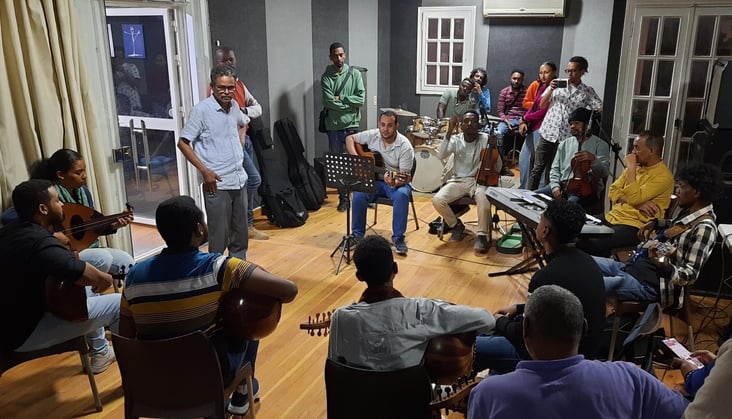
Cairo has become home to several groups of Sudanese diaspora musicians, refugees from war who are forging community and musical links in Egypt.
The air of a large hall in one of Cairo’s studios vibrates with the sounds of Sudanese music. A choir of 20 singers, accompanied by eight instrumentalists, have come together to breathe life into their rich heritage; their music is filled with hope and nostalgia, while lyrics reverberate with the stories of their homeland.
“We are Sudanese Voices (Aswat Sudaneya), a choir launched in April,” the group’s founder Elsafi Mahdi tells The Africa Report, introducing the ensemble.
The first Sudanese Voices were established in Khartoum to preserve and promote Sudanese music. Escaping war, the prominent musician, conductor and lecturer at the College of Music and Drama, Sudan University of Science and Technology, arrived in Cairo in January. From its new base, the choir continues its mission, now embracing the diaspora and providing its members with a sense of togetherness while spreading Sudanese music throughout Egypt.
Uniting people in harmony
The ensemble comprises musicians from diverse backgrounds, ranging from their late teens to those in their fifties. “We are primarily Sudanese nationals, refugees who fled the war. Our repertoire features traditional Sudanese music, but we also include classic Egyptian songs, which help us connect with our new audiences here,” he explains.
Positive energy fills the hall, creating a warm blend of friendship and focused effort as the choir rehearses segments of ‘Azza Fi Hawak’ (Proud in Your Love). This iconic song embodies the rich cultural heritage of Sudanese music, reflecting themes of love, longing, and devotion while honouring the country’s identity.
“This is a hymn of love to Sudan,” Wala Awad says. Awad is the only choir member who came to Egypt before the war to study music. “I am a solo singer, and this is my first experience in a choir. I’m learning a lot from maestro Mahdi; he has an amazing technique and is both our great mentor and a brother.”

Another singer, Nader Othman, studied music with Mahdi in Sudan for over a decade. “I joined the choir the moment I learned the maestro relaunched it. As we continue our dedication to Sudanese heritage music in Cairo, the ensemble also embraces our stories and journeys,” he says.
Africa Insights
Wake up to the essential with the Editor’s picks.Sign upAlso receive offers from The Africa ReportAlso receive offers from The Africa Report’s partners
Several members of Sudanese Voices have musical experience, with a few having previously studied with Mahdi. Newcomers are often invited by their compatriots. “We welcome those without formal music education too; they receive training with us,” Mahdi says in his signature warm voice.
Sudanese music in exile
Mahdi’s choir is one of many new Sudanese music ensembles surging forth across Egypt.
Dafallah Al-Haj, an academic, musician, and researcher, fled Sudan two months after the outbreak of war. Among his many efforts to preserve Sudanese musical heritage and its instruments, back home he established the Camerata in 1997, an ensemble that performed both within Sudan and at numerous festivals worldwide.
The founder of the Sudanese Centre for Traditional Music and Museum in Khartoum, Al-Haj, chisels instruments in his Cairo workshop. This work feels like an attempt to compensate for more than 300 instruments he collected or crafted throughout his decades-long career, and which were looted and destroyed in the early weeks of the war.
The recently crafted drum-like tambours and naggarahs are now being incorporated into the Camerata for Folkloric Arts, a new ensemble he founded in Egypt.

“All Sudanese love art, especially music. They engage with it in various ways, and it serves as a common social practice. Music from the diverse regions and tribes of Sudan reinforces the cultural identity of its people,” Al-Haj explains, adding that the Cairo-based Camerata includes Sudanese singers, instrumentalists, and dancers – some professional performers and others learning alongside them.
Together in music, challenges remain
A year and a half into the war in Sudan, these musicians have become a vital part of Cairo’s cultural landscape. However, as members of the Sudanese diaspora, they continue to face numerous obstacles.
“The musicians lost a great deal. In terms of their work, much of their research, music notes, computers, and instruments were left behind, lost, or destroyed in Sudan,” says Adel Harbi, president of the Sudanese Artists Union and vice president of the Arab Artists Union in Cairo. “These are extremely harsh circumstances for anyone, including artists. Still, they persist with music and invite others to join, finding in it the emotional healing.”
Harbi emphasises that many members of the music ensembles hold other jobs, often as teachers or factory workers, while only a few professional artists rely solely on music for their income.
Hoping to improve the artists’ financial situation, Harbi is working to resolve the legal obstacles that hinder many performance opportunities. The Egyptian Music Syndicate imposes significant fees on foreigners seeking performance permits to work in Egypt, hence their access to many commercial stages is almost impossible.
“It’s easier for the diaspora to perform inside the foreign cultural centres, at events linked to UNESCO, the UN Refugee Agency, etc.,” he says.
Music as soft power
“Even if stages are limited, we will continue making music. It is our tool for peace,” says Omer Himaeda, introducing the Salam Band (which means peace). A medical graduate from Khartoum, he prefers not to identify as the band’s founder, stating, “We are 20 Sudanese people – women and men of different ages –who came to Egypt fleeing war. We create this project together and choose the songs together.”
Many members of the Salam Band were students at Beit El-Oud (Oud House) in Khartoum. Now regrouped in Cairo, they perform a mix of songs and instrumental music that highlights Sudanese heritage alongside several Oriental tunes.
“We have seen the impact of war firsthand. Instead of dwelling on the past, we’re using our love for music to spread a message of peace and hope,” Himaeda says, quoting the band’s mission from their website. He adds that the band’s music tells stories of displacement, resilience, and strength, and serves as a tool for raising awareness and fostering change.

 Ati Metwaly