From the ancient stones of Jordan’s Jerash to the open-air stages of Oman’s Salalah and back to the Red Sea coast, Harmony Araby Choir has spent the summer taking Egyptian and Arab music beyond Egypt’s borders. The choir’s journey began with a university ensemble and grew over the years into a group of more than 200 singers. (Published in Al-Ahram Weekly)
In recent weeks, Egypt’s Harmony Araby Choir has taken its voices past the country’s borders twice, performing in Oman and Jordan. Their mini tour began with two concerts on 27 and 28 July at the 40th Jerash Festival for Culture and Arts. There, as the Jordanian press reported, “during the ensemble’s concert, the historic stone pillars of Jerash echoed with the sounds of Arab heritage.”
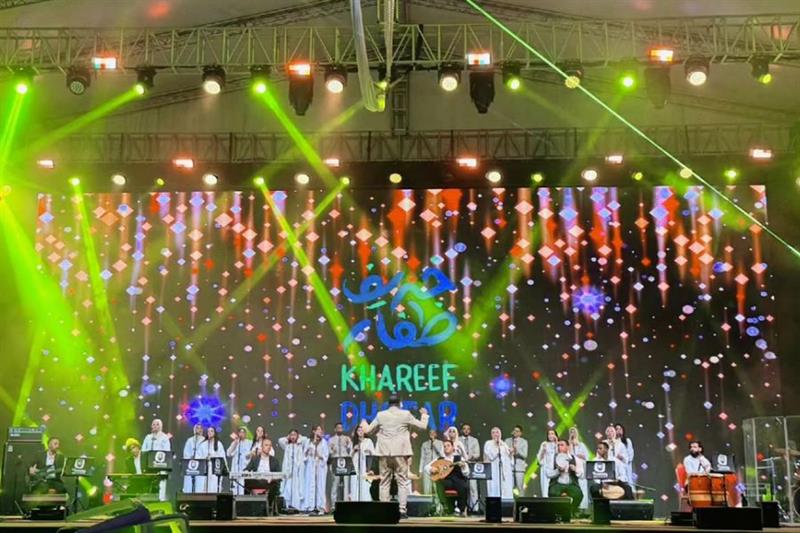
From Jordan, the choir travelled to Oman to perform on 30 July and 1 August at Salalah’s Atin Square as part of the Khareef Dhofar Festival, one of the Gulf country’s largest cultural and tourism events. The festival, held across Salalah and the surrounding areas during the region’s distinctive khareef, or monsoon, season, brings together a wide programme of concerts, theatre performances, exhibitions and family entertainment.
The journey continued back in Jordan, where the choir performed at the Amwaj Al-Aqaba Festival on 21 August, a seaside celebration in the Red Sea city of Aqaba filled with music, poetry and folk performances.
For founder and conductor Mahmoud Waheed, these recent performances are part of a story that began many years ago with university students, rehearsals and a fascination with what happens when individual voices become one. Today, the Harmony Araby Choir has more than 200 members of different ages, performing Arabic classics, folk songs, religious heritage, anthems and contemporary music.
“It all began with a choir at Ain Shams University, where I studied commerce,” Waheed recalls the early 2000s. He was instantly drawn to the university’s extensive artistic activities, particularly its theatre and choir. “I was just a singer at one of Ain Shams University choirs, yet soon I realised that music was my true passion,” he comments on how he started discovering his own voice and gradually took steps towards further training.
Throughout the 2000s, he took numerous workshops and enrolled in open studies at the Faculty of Music Education and the Cairo Opera, honing his skill as a bass-baritone, as well as a composer. In 2008, he joined the Cairo Opera House’s A Cappella Choir, which specialises primarily in the Western classical choral repertoire, and shortly after he was awarded an honourary doctorate by the London College of Music in Egypt.
Big steps in music were paralleled by moving between the roles of performer, conductor, and trainer, working with university choirs at Ain Shams, Cairo, and Menoufiya universities, and at the Academy of Culture and Sciences. Between 2013 and 2021, Waheed also trained an all-girls choir at the Faculty of Women for Arts, Sciences, and Education (widely known as Kolleyet Al-Banat or the Girls’ College) at Ain Shams University in Heliopolis, an experience that gave him a particularly close view of how singing could affect confidence and a sense of agency.
He remembers girls who initially struggled even to look at their conductor while singing. “In the first year, some girls were afraid to sing, to let their voices take on power. They would not even look into my eyes,” he recalls. Over time, however, some would develop enough confidence to become choir leaders, choosing songs, directing their peers and even taking on the role of conductor. “It was an amazing process, watching the girls discover their power, become more confident, and formulate their creative opinions.” The experience reinforced the idea that a choir could offer something beyond musical training: it could give people the confidence to find and use their own voice.
While he enjoyed working with university students, the structure of the university system presented a different challenge. “A student could enter the choir in the first year, spend a few years developing technically and personally, and leave just as he or she reached artistic maturity,” Waheed explains.
For a conductor, this meant constantly rebuilding the group. “I kept losing people, a process that was challenging not only on an artistic but also on an emotional level. There was a bond we formed and certain values we shared, and members leaving upon graduation always affected the choir,” he says. Somehow unintentionally it was Covid-19 that set a different path into motion. The pandemic brought live performance to a halt, but it also prompted Waheed to reconsider where a choir could find its audience. “In 2020, when we were all home, I discovered the importance of social media. I thought, why don’t we use them to present what we do to a wider online audience?”
The choir chose a name independent of the university — Harmony Araby Choir — and began recording and publishing its music online, marking its first step beyond the university stage.
This move has actually exposed the choir to a much wider audience and, even more importantly, it gave Waheed a way to understand what listeners responded to. “At the university, the repertoire had been largely centred on the great figures of Arabic music: Um Kolthoum, Sayed Darwish and Mohamed Abdel-Wahab, among others. The online audience encouraged a broader approach, and at the same time opened the door to reconnecting with members that would no longer attend the university rehearsals,” he clarifies. The pandemic therefore had an unexpected effect: it not only gave the choir a new name, but also pushed it towards a new way of thinking about music, audience, and repertoire.
Waheed dates the founding of the Harmony Araby Choir as we know it today to 2022. An important element characterising the ensemble from the outset was expanding the repertoire to include contemporary songs from Amr Diab and Sherine Abdel-Wahab to Fairuz, alongside Egyptian and Arab folk traditions. The choir began exploring musical material associated with different parts of Egypt, from Alexandria to Aswan.
When the war on Gaza broke out in October 2023, the choir was among the first ensembles to present a Palestinian medley online. It also developed other themed medleys: songs from Syria, wedding songs from Sudan, national songs spanning different periods of the 20th century, and arrangements built around particular occasions. For Christmas, the choir experimented with taking a popular Egyptian folk melody and setting Christmas-related lyrics to it.
Since its formation as Harmony Araby Choir, the ensemble has quickly gained momentum. “The very first concert we held under this name was our participation in a UNESCO event at Ain Shams University devoted to the voice. Entitled “Week of the Voice”, the event explored the human voice in its different forms, including how voices are produced and transformed across different environments and cultural contexts. Harmony Araby participated with a large ensemble of around 180 singers, performing medleys based on Egyptian folk material alongside other vocal arrangements.”
The choir’s social media accounts are an extension of its artistic work rather than merely a promotional platform. Needless to say that it also brought along new opportunities with concerts in Egypt, soon followed by appearances on programmes hosted by Mona Al-Shazly, Amr Adeeb and other household names, and concerts on the stages of other Arab countries. The choir also began building a more professional operation around its growing visibility, bringing in specialists in marketing and social media.
While Waheed remains in charge of the choir’s trajectory, setting the artistic vision, training and conducting the ensemble, he has assigned Ahmed Badea the role of musical director and Mahmoud Awad that of managing director. Waheed stresses the support he receives from other team members in charge of a variety of artistic and administrative tasks: Mohamed Raouf, Nessma Mustafa, Menna Nassrat, Ahmed Medhat, and his wife Amal Ezz, in charge of social media.
A great boost of confidence came in 2024, when the ensemble won first prize on Egypt’s Got Talent, following three weeks of competition among 18 talents from different Egyptian governorates. That same year, the choir was featured in a Ramadan television advertisement for Banque Misr, starring Ahmed Saad.
To date, the choir’s portfolio boasts hundreds of concerts across Egypt, many on prestigious stages, and performances throughout the Arab world, including Saudi Arabia, Jordan, Kuwait, and Oman. “When we visit another governorate or another Arab country, we often incorporate their traditional repertoire into the songs,” Waheed explains. The approach reflects the choir’s broader understanding of Arabic music as a network of traditions that can speak to one another.
Waheed sees music as something deeply embedded in everyday life, rather than an activity reserved for those who consider themselves musical. He points to traditions such as mourning poetry, Quranic recitation and other forms of vocal expression as evidence that people use rhythm, melody, and vocal inflection to communicate emotions even when they do not consciously think of it as music.
“Even if you do not practise music in its popular sense, people express themselves in a musical manner; it is through vocal inflections that they convey their emotions,” he says. For Waheed, singing can express happiness, sadness, love, disappointment and acceptance of others; singing together adds another dimension, creating a shared energy and bringing people closer.
Today, the choir has more than 200 singers in its books, although regular rehearsals typically bring together around 60. For international engagements, the group is scaled down further to accommodate the costs and practical demands of travelling with a large ensemble. Its social media following, now exceeding two and a half million across Facebook, Instagram and TikTok (and more than 500 million views), has prompted the choir to professionalise some aspects of its operation. The choir wears uniforms or unifies its colors, and generally works with a relatively small group of musicians. It has also begun offering modest fees to participating members.
For all the growth, experimentation and professional development that shaped Harmony Araby Choir, its essence remains remarkably simple: people coming together to sing. What distinguishes the ensemble is the palpable enthusiasm its members bring to every performance. Their smiles, energy and obvious pleasure in making music are as much a part of the experience as the songs themselves, whether in rehearsal or before an audience. That spirit is infectious, turning Harmony Araby’s concerts into more than a showcase of Arabic music: they are performances that invite audiences to share in the singers’ excitement and leave with some of that energy.


