As the 34th Arab Music Festival approaches amid a wave of artist withdrawals and rallying expressions of support for the Cairo Opera, a look back at its storied history reveals urgent questions about how the festival itself must adapt to survive a rapidly shifting cultural landscape. (Published in Al Ahram Weekly)
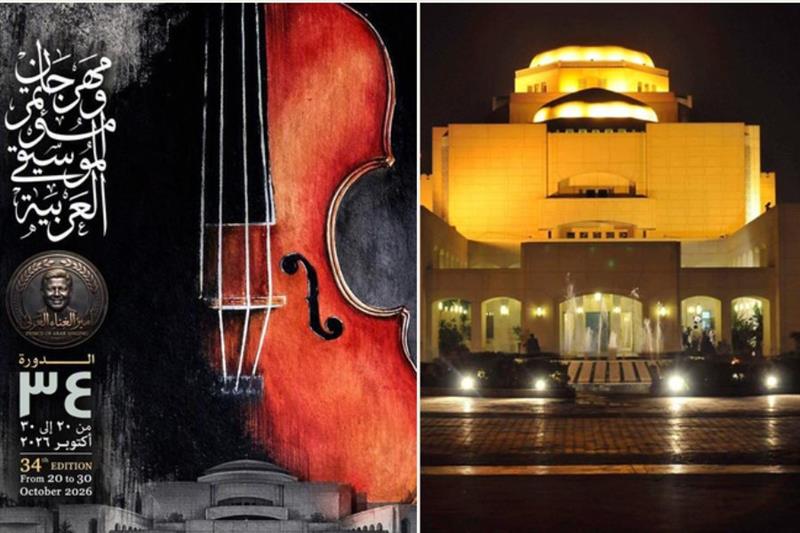
The current situation is dynamic, and things will have developed since Sunday 4 October, when this article was written.
The social media debate was set off by a press conference held on 30 September, during which Opera chairman Reda El-Wakil cited the budget limitations affecting the choice of participating artists. His remarks pointed to an inability to attract a larger number of major stars, and a need to capitalise on the presence of Cairo Opera artists. Those statements drew a series of responses from the artists, ranging from withdrawals of prominent musicians and singers to expressions of support for the institution that gave a stage to numerous names through the festival’s history.
From the outset, artists who took issue with the chairman’s remarks about budget limitations began sharing the details of their fees, the musicians’ pay and contractual terms. On 1 October, in the midst of withdrawals and heated discussions on social media, El-Wakil released a post on his Facebook account announcing his intention to resign just four months after the renowned bass singer was appointed.
He opened his post with “Before I leave you in peace,” and followed with the expression that he had wished to stay until the end of his appointment since he believed he had the ability to bring about change. El-Wakil said he would not let anyone control his choices regarding an Egyptian artist whose talent he trusted and who was loved by the public. The wording prompted questions about whether he had actually resigned.
A day later, on 2 October, El-Wakil published another statement on Facebook, explicitly confirming that the 34th Arab Music Festival and Conference would take place as scheduled. He wrote that the festival would feature numerous artists including those from the Cairo Opera whom he referred to as “loyal Egyptian artists”. With no clear statement on El-Wakil’s potential resignation, the lack of clarity was widely interpreted by the press as suggesting that he would remain in office. The Cairo Opera House has released no additional information.
The 48-hour period between the press conference and El-Wakil’s social media statements set in motion a broader dispute between the artists. Veteran Egyptian singer Mohamed Tharwat announced that, despite participating in the festival for many years, he would not take part in the 2026 round. “I will not agree to, or participate in, insulting Egyptian art or Egyptian artists,” he wrote, referring to discussing financial matters publicly.
Tharwat revealed that not only had he performed for free on many occasions in the past but this year he had agreed to take no more than 25 per cent of his regular pay. He described his withdrawal as an opposition to the lack of “professional codes and respect for established artistic figures”. He objected to El-Wakil’s statements, arguing that an artist should not become “a number in a press conference”. Tharwat also pointed to a troubling clause in his contract, which made him legally responsible for performing works by other artists, including Abdel-Halim Hafez and Mohamed Abdel- Wahab. Since he does not own the rights to those works, he had been promised that the clause would be removed. But, according to the singer, the Opera had not amended the contract.
Another veteran artist and one of the staple singers of the Arab Music Festival, Ali El-Haggar joined Tharwat in withdrawing from the festival – a decision he rectified two days later. El-Haggar, who had gone on the festival’s stage every year since its launch in 1992, explained his decision is in response to the “meagre and insulting” budget allocated by the Cairo Opera to the musicians accompanying him, “a fact that the Opera chairman chose not to address during the press conference,” he wrote on his Facebook page.
But in the early hours of Sunday 4 October, El-Haggar addressed his two million followers on Facebook with these words: “Thanks to the Cairo Opera House and Dr Reda El-Wakil, for responding to the demands of the musicians of the Opera. God willing, I will be with you at the Arab Music Festival on Saturday, 24 October in Cairo, and on Thursday, 29 October at the closing ceremony of the festival at the Sayed Darwish Theatre in Alexandria.”
Still, the list of withdrawals continued to grow, reportedly including other Egyptian singers: Mohamed El-Helou, Mohamed Mohsen, Ramy Sabry and Marwa Nagy. The Lebanese singer Assi El-Hallani too announced his withdrawal from the festival through his X account, citing the “recent administrative developments” at the Cairo Opera, and adding that the deep respect he holds for the Opera and its audiences does not allow him to be part of “any disputes or complications”.
Some artists publicly expressed support for the festival and the Opera House administration. Egyptian singer Ghada Rajab, who is scheduled to perform twice during the upcoming round, took to Instagram to thank the Cairo Opera and its chairman for his work. She praised El-Wakil’s “exceptional efforts” and ability to “endure difficulties”.
In a post on her Facebook account, singer Nadia Mustafa wrote, “I wasn’t planning to speak, but having read some comments, I felt it was necessary to respond… I would like to clarify that I was among the first to offer to participate gratis in the opening of this year’s festival. Simply being on the stage of the Cairo Opera House is a great honour for me; indeed, it is an honour for any singer, regardless of their artistic standing.” She then encouraged other musicians to follow her lead.
Singer Enas Ezz Eldin confirmed her participation, as a child of the Cairo Opera House, an institution she thinks of as her second home. “We have stood by the Opera through good times and bad. We suffered with it, witnessed its successes and carried it through crises. We have been upset with one another and disagreed with one another, but all of this was because we love the place and consider it our home,” she said, adding that she would waive her fee “however small or modest it may be, in support of my home at a very difficult time”.
Other artists took to social media to express concerns related to the standing of the Arab Music Festival and Conference, which despite its rich history and weight in the Arab region suffers from severe financial constraints. Those commentators pointed to the lack of sufficient sponsorship and minimal budget allocated for an event that deserves to be supported generously.
Along those lines, maestro Hany Farahat pointed to marketing and sponsorship as important elements in strengthening the festival, arguing that the issue should not be reduced to artists’ fees. But what might we conclude from the current “controversy”, as the media has been calling it? One undeniable fact is that the festival is reaching its critical point. I would not describe the crisis as a controversy, but rather an issue that has been mounting over the years, with El-Wakil’s remarks at the press conference merely opening a previously lidded Pandora’s box.
Whether artists were disappointed or had to make difficult concessions, sooner or later, it was bound to come to light. In fact, while the financial aspect is fundamental to this conversation, the budget and the percentages that the musicians are willing to deduct from their expected pay are merely indicators of much deeper issues. The full picture carries shades of the operational context that shaped this festival through the years, including artistic and administrative choices and budgetary constraints, all under successive managements. When amplified by the economic pressures affecting artists and arts administrators in their personal lives, the pot is far more likely to boil over.
Indeed, even if the current issue is resolved, the choices to be made by the management of the Arab Music Festival and Conference are crucial in the long run. After all, a festival with such history behind it needs practical tools to continue claiming its leader position on the regional scene.
Decades of history
The history of the Arab Music Festival and Conference as we know it today goes back to 1992, when it was founded by a renowned soprano Ratiba El-Hefny (1931-2013), former chairwoman of the Cairo Opera House (1988-1990). The festival aimed at reconnecting with Arab collective memory through its songs and music, alongside intellectual gatherings bringing together scholars and performers.
However, the real story of the festival takes us further back to 1932 when the First Congress of Arab Music was held in Cairo. A forefather to today’s festival, the congress (28 March-3 April 1932) saw the participation of numerous scholars from all across the Arab world (Egypt, Iraq, Tunisia, Syria, Morocco, Algeria), including Mahmoud Ahmed El-Hefny, none other than Ratiba El-Hefny’s father, as well as Turkey (which shares much of the same musical tradition).
The congress focused on the past, present and future of Arab music – referred to back then as “Oriental music” – with clear objectives: establishing a solid scientific foundation for it, exploring ways to further its development, collecting and documenting its modes, scales, vocal and instrumental compositions, and reviewing the quality of its instruments, among others.
It was an attempt to establish an annual tradition bringing together those interested in Arab music and its practices, as well as provide a range of musical performers with an opportunity to take the stage. The congress initiated the recording of 360 performances of Arab music by the visiting groups, many of which are now catalogued in musical and ethnographic institutions in Paris, London, and Berlin.
The First Congress of Arab Music has not been repeated in Egypt, yet in the following decades, similar meetings aiming to document Arab genres were held in Fez and Tripoli, alongside Spain and France. Sixty years after the initial congress, Ratiba El-Hefny decided to revive this idea.
The inaugural Arab Music Festival and Conference kicked off on 23 November 1992 and lasted six days with the participation of 42 researchers from 13 Arab countries, featuring both concerts and seminars. The inaugural date also coincided with the 25th anniversary of the Arab Music Ensemble which was launched in Cairo in February 1968. Seventy members of that ensemble were honoured during the opening round.
The following rounds introduced new components including competitions for young talents in oud playing – an initiative that soon expanded to other instruments – and in 1997, the competition for the traditional takht sharqi ensembles launched with numerous groups from across the Arab region. The 1998 edition added improvisation and taqasim on Arab musical instruments.
Through the decades, the festival drew hundreds of solo musicians, ensembles and scholars, each leaving an important imprint on its development.
El-Hefny remained at the festival’s helm until her death in 2013, after which Gihan Morsi took over its management, heading the festival until 2022. As Morsi herself stressed, her management focused on preserving the foundations El-Hefny had established while broadening its reach. In several interviews, Morsi already complained of budgetary challenges pressuring the festival. In one of them, she expressed her gratitude to participating Arab stars for accepting the “very symbolic wages” or thanked them for their “unpaid contribution”.
Following Morsi, the directorship of the Arab Music Festival began changing rapidly. Maestro Hany Farahat was appointed director of the 2023 edition but the festival was ultimately postponed. In 2024, Khaled Dagher took over its leadership, while Tamer Ghoneim directed the 2025 edition. This year the festival is headed by Mohamed El-Mougy, who came along during El-Wakil’s chairmanship of the Opera.
The artistic trajectory of one of the Arab world’s most important music festivals thus evolved through a succession of ideas and approaches, as consecutive directors have sought to leave their mark on its identity and direction. Through this journey, the festival’s financial constraints have never been a secret, surfacing at times through indirect references and, on other occasions, being mentioned more explicitly.
Navigating the future
Beyond El-Wakil’s remarks at the press conference and the commotion that followed, the fundamental question remains: What is the future of the festival? How can an event of such importance sustain and develop its role as an influential element in Arab music when its financial realities increasingly appear out of step with its ambitions? How can an initiative of such weight remain sustainable against a backdrop of rapidly changing socio-economic realities and shifting cultural priorities, already evident in Egypt and even more so across the Arab region?
Those challenges are compounded by continuous changes in management, both at the festival and at the Cairo Opera House, and changing approaches and strategies to the artistic, administrative and marketing landscapes. The response cannot be ad hoc: a fresh coat of paint on a vessel already struggling to stay afloat. It is obvious that the festival requires strategy and long-term planning, grounded in an understanding of the new cultural map of which Egypt has become part, whether by choice or through influences beyond its control.
With stages bustling with concerts across the Arab Gulf – UAE, Saudi Arabia, Kuwait and other Arab countries – attracting regional stars and thousands-strong audiences, the sustainability of the festival might be legitimately in doubt.
The sheer love of tradition – and of the Cairo Opera – might not be enough for the artists to remain dedicated to the Egyptian stage.
On the other hand, over several years now, the Egyptian musicians began joining ensembles performing outside the country. Many have made the Gulf their permanent home, seeking relief from growing financial pressures in their home country. And there are scores of talented musicians whose livelihoods are closely tied to the opportunities available locally, including work with the Cairo Opera House. As maestro Hany Farahat indicated, the Cairo Opera might need to revise its marketing techniques.
Long-term cultural investment patterns that strategically generate income for both soloists and accompanying musicians are definitely worth rethinking. This comes along with a deliberate gravitation towards regional and global star power in Egypt and across the region, over the past few years. In Egypt only, the Grand Egyptian Museum (GEM), public events at the Pyramids, the City of Arts and Culture at the New Administrative Capital, stages across the satellite city of Madinaty, El-Gouna, Soma Bay, Hacienda Bay, Marassi Beach Resort and New Alamein City are among the venues capitalising on star power while catering to audiences who can afford tickets for those events.
Of course, much of this repertoire falls outside the Arab Music Festival’s scope. Yet the same venues regularly spend large sums to host artists who appear on the Arab Music Festival’s stages (for a drastically reduced or no fee!). While marketing strategies need revision, the Culture Ministry has its own share of responsibility for this historical festival.
The Arab Music Festival and its history can generate better attention, attract sponsors and shine on Arab television channels everywhere. This could also provide greater exposure and add value to the many activities taking place alongside the concerts: showcases of emerging talent, seminars by scholars, documentation and research, discussions about the future of Arab music, and ongoing negotiations between tradition and new trends. At its heart, the festival was conceived to help shape the path of Arab music, rather than showcase the stars. The latter, however, could attract attention, particularly in today’s cultural landscape, where relying on tradition to sustain itself may no longer be enough.
The festival’s future thus increasingly depends on those who understand how to communicate, market and position it for a new audience. We are no longer in the 1990s, when audiences had fewer cultural choices, fewer competing screens and more time to engage with what was available. We are living in an era of speed and low attention spans, where commercial priorities are constantly competing and cultural initiatives must find ways to communicate their values amid the noise.
The times have changed, and so must any cultural initiative hoping to evolve with them. Looking to the future does not mean abandoning the past; it means creating vibrant links with the future, experimentating and finding fresh ways to engage audiences both artistically and organisationally. All of which is at the heart of what the Arab Music Festival and Conference was founded for.


