In the Emirati production Jasmine’s Fingers (Asabe’ Al-Yasmeen), staged during the 4th Eazees International Women’s Theatre Festival (25 September–2 October), an intimate story of love and deception unfolds into a meditation on illusion, physical appearance, and the scars left by violence. (Published in Ahram Online)
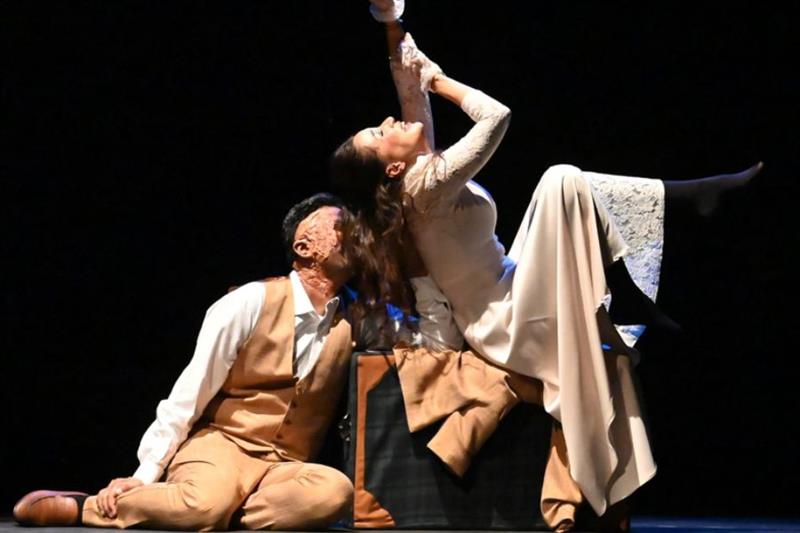
Following its revival as the opening production of the 9th Dibba Al-Hisn Festival for Duo Theatre, an annual theatrical event held in the UAE focused exclusively on duo drama, the Khorfakkan Arts Theatre’s production of Jasmine’s Fingers brought a haunting, intensely psychological theatrical experience to Cairo Hanager Theatre‘s audiences.
One of the most vibrant regional troupes in the Emirate of Sharjah, the theatre dates back to its 1988 launch as Al-Tali’ah (Avant-garde) Theatre in Khorfakkan before officially taking its current name in 1996.
Originally penned by Iraqi playwright Ahmed Al-Majed, the play was first staged at the 7th Dubai Youth Theatre Festival in 2013 by Dubai Al-Ahli Theatre under the direction of Emirati director Murtada Jumaa. This 2026 production features mise-en-scène by Emirati director Elham Mohammed and stars Ahmed Abu Arada and Khadija Al-Bakoush.
Mohammed handles the text with measured theatrical language, trusting its psychological tensions rather than overloading them with visual effects. Abu Arada and Al-Bakoush carry the demanding two-hander with a strong sense of presence, gradually revealing the unease and emotional distance beneath the couple’s seemingly intimate encounter.
The dramatic structure moves between two parallel timelines: the present wedding night and a retrospective narrative that gradually uncovers past secrets, sacrifices, and betrayals. Though this gives the production considerable freedom in shaping its spatial and visual language, the director opts for a deliberately sparse set centred on a single prop: a suitcase.
It shifts function throughout the performance: at times a traveller’s object, at others a chair, a step, or a box of memories, continually suggesting movement and instability while evoking the passage of time and a past that refuses to be buried.
One of the text’s strengths is its capacity to invite multiple readings. On one level, Jasmine’s Fingers is a drama about the aftermath of war, with violence made tangible in the physical disfigurement of the male protagonist. Yet the scars on his body also become a gateway into broader questions of identity, perception, and human psychology.
Known for his symbolic, expressive, and absurdist modes in theatre, Al-Majed created a text that asks how we construct people in our imagination through words, especially when that imagined version collides with the uncompromising reality of the body before us.
At the core of the narrative is a profound tension between text and flesh. The female protagonist, a woman approaching her 40s, burdened by societal pressure and a desperate longing for security, has been wooed by a man through poetry and romantic correspondence.
In her mind, nourished by his eloquent verse, she has constructed an idealized partner: a man of intellectual depth, emotional resonance, and unblemished grace.
The tragic turning point arrives on their wedding night. Standing on a bare stage in her wedding gown, she anticipates the realization of her dreams. Instead, she encounters a man wrapped in shadow, his right hand motionless as if paralyzed, his face severely disfigured by a past bombing intended to harm her own brother.
The latter revelation exposes a double betrayal. Not only did the groom conceal his physical disfigurement behind the romantic shield of his poetry, but her brother, who arranged the match out of a complex web of guilt and protective obligation, also kept her in the dark.
The play belongs to a broader theatrical tradition in which words become the architecture of an imagined beloved: from Cyrano de Bergerac, where one man’s words are attributed to another’s face, to Cocteau’s The Human Voice, where an absent lover exists almost entirely through a woman’s words and perceptions.
When the bride in Jasmine’s Fingers cries out that he “did not fill her imagination,” she articulates a modern existential disappointment. The play interrogates how much of romantic love is directed toward an actual human being versus a projection we manufacture from words, letters, and longing.
Yet beneath this exploration of romantic illusion lies a darker historical context. While contemporary criticism of the 2013 premiere understandably linked the play’s atmosphere of bombings and concealed faces to the collective trauma of modern Iraq, the 2026 Khorfakkan production demonstrates that Al-Majed’s text reaches well beyond a localized political allegory.
The title itself operates on a rich metaphorical plane. “Jasmine” evokes beauty, tenderness, and fragile hope, while “fingers” suggest external forces, political violence, familial manipulation, or self-preservation that touch, shape, and ultimately damage human lives.
As the dialogue unfolds, the stage becomes a psychological battleground in which the characters negotiate a fragile relationship between concealment and revelation.
In a production driven by duo-theatre mechanics, an empty stage places immense demand on both actors and director. Elham Mohammed’s mise-en-scène uses spatial isolation, spotlights, shadow, and stage fog to shape an atmosphere of uncertainty, blurring the boundaries between memory, imagination, and the present moment while mirroring the emotional gulf between the newlyweds.
It is ultimately the two performers who must sustain this sparse theatrical world, and both rise to the challenge with palpable commitment. They fill the minimalist space with tension, using their bodies and voices to give physical form to the play’s psychological conflicts.
At the same time, translating such a dense psychological text into a fluid performance reveals the immense challenge of maintaining theatrical momentum. On the performance front, Khadija Al-Bakoush delivers a visceral portrayal of the bride, while greater tonal variation might have given the overall rhythm even more breathing space.
Ahmed Abu Arada adopts an internalized posture as the husband, a choice that reinforces his emotional withdrawal, though it occasionally makes the exchanges feel more like parallel inner monologues.
The performance is accompanied by light Western music, which, while attempting to mirror the ebb and flow of the characters’ emotions, gives the production a more contemporary and international sonic language. Yet the continuous presence of the background score sometimes works against the dramatic tension. In intimate duo theatre, silence is an active instrument that can effectively mould, shape, and stress the gravity of pivotal lines.
Despite these pacing and staging frictions, Jasmine’s Fingers ultimately fulfils its structural ambitions, carrying the audience from a domestic confrontation into a Beckettian portrait of almost absolute isolation.
The performance gradually becomes a haunting psychological puzzle, leaving the audience to grapple with questions of memory, guilt, and loss. As the final lines are delivered, the tragic irony of the characters’ shared fate comes into focus, yet a lingering ambiguity remains: to what extent was he a figure of her imagination, and to what extent were they both trapped within an illusion of their own making? The questions linger beyond the performance, leaving the audience with more to contemplate than to resolve.
Ahmed Al-Majed’s text, elevated by the Khorfakkan Arts Theatre’s willingness to successfully experiment with minimalist staging, proves that Jasmine’s Fingers is a vital contribution to contemporary Arab theatre. It strips away the romantic varnish of epistolary love to expose the raw, uncomfortable mechanics of how we deceive ourselves and others, leaving us standing in the quiet aftermath, staring at the ghosts we leave behind.


