A growing controversy surrounding the 34th Arab Music Festival and Conference has raised questions about budgets, artists’ fees, artistic decision-making and the future direction of one of Egypt’s longest-running specialised music festivals, just weeks before its scheduled opening on 20 October. (Published in Ahram Online)
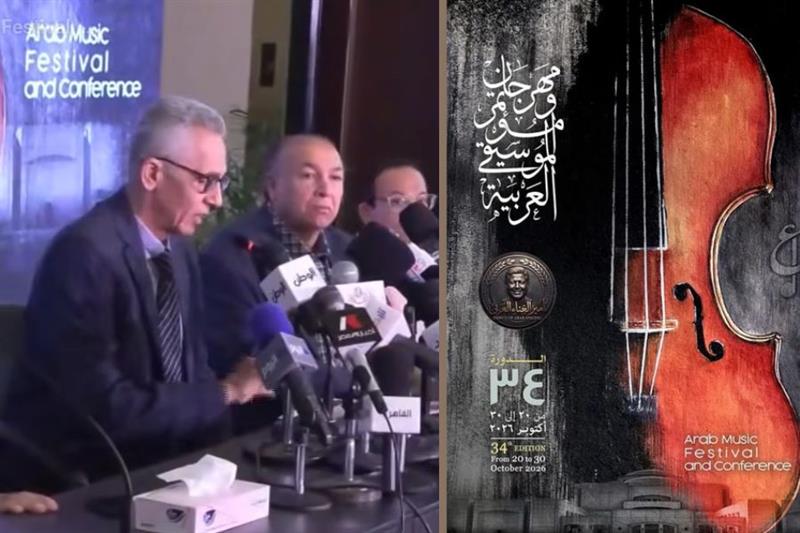
The controversy began to intensify after Cairo Opera chairman Reda El-Wakil spoke at a press conference held last week about the financial constraints facing the festival and the difficulty of attracting a larger number of major stars. The remarks were followed by a series of withdrawals and public statements from prominent Egyptian musicians and singers.
Ali El-Haggar, who has participated in the festival since its establishment, announced that he would not take part this year. He attributed his decision to what he described as an inadequate budget allocated for his accompanying musicians. “This is the fact that the Opera chairman chose not to address during the press conference,” El-Haggar commented.
Mohamed Tharwat subsequently announced his withdrawal, initially saying he would not accept what he regarded as a devaluation of Egyptian artists. He explained that his objection and decision not to participate this year concerned “professional principles, industry codes and respect for established artistic figures,” rather than reducing art to discussions of figures and budgets or using it for matters unrelated to its fundamental mission.”
He added that he had not signed his contract and objected to several provisions, including a clause that he said would have placed legal responsibility on him for works by other composers and for traditional songs whose rights he does not own. He also said he had already agreed to waive more than 75 percent of his fee.
The dispute has also involved questions about the festival’s artistic choices. Maestro Amir Abdel-Meguid criticised the suggestion that the absence of some Arab stars could be explained by financial limitations, stressing the importance of major Arab musicians to an event bearing the name of Arab music.
Maestro Hany Farhat, meanwhile, pointed to marketing and sponsorship as important elements in supporting the festival, arguing that the issue should not be reduced to artists’ fees alone.
At the same time, the Opera has highlighted efforts to work within its financial constraints. El-Wakil said pianist and composer Omar Khairat agreed to receive half his usual fee so that part of the budget could be directed towards improving the salaries of Opera singers.
Amal Maher and Assi El-Hellani were also reported to have agreed to waive their fees, while singer Nadia Mostafa said she had volunteered to perform at the opening without payment and encouraged other colleagues to do the same.
In a statement posted on his official X account, El-Hallani’s media office said the singer had been scheduled to perform at the new edition of the Arab Music Festival on 22 October 2026, but had decided to withdraw due to recent administrative developments at the Cairo Opera House.
In a post on her official Facebook account, Mostafa wrote: “I wasn’t planning to speak, but after some people’s comments, I felt it was necessary to respond,” and added: “I would like to clarify that I was among the first to offer to participate in the opening of this year’s festival without a fee. Simply being on the stage of the Cairo Opera House is a great honour for me; indeed, it is an honour for any singer, regardless of how high their artistic standing may be.”
The dispute took a further turn on 1 October, when El-Wakil announced that he would step down as head of the Opera House, saying he had hoped to complete his term but would not accept interference in his choice of artists. A renowned bass singer, El-Wakil was appointed chairman of the Opera House last June, succeeding conductor, cellist, composer and academic Alaa Abdel Salam. On 2 October, El-Wakil published another statement confirming that the Arab Music Festival would go ahead as scheduled, without officially clarifying the status of his earlier resignation.
Singer Enas Ezz Eldin announced that she would participate in the Arab Music Festival, saying she was taking part as one of the Cairo Opera House’s artists and considered the institution her second home.
“We have stood by the institution through good times and bad. We suffered with it, witnessed its successes and carried it through crises. We have been upset with one another and disagreed with one another, but all of this was because we love the place and consider it our home,” she said adding that she would waive her fee “however small or modest it may be, in support of my great home, the Cairo Opera House, at a very difficult time.”
Despite the controversy, the festival remains scheduled for 20–30 October. The programme includes concerts, alongside research, seminars and cultural activities, with this year’s edition dedicated to the late singer Hany Shaker.


