“Sport changed my life; it altered my way of thinking and gave me purpose. It taught me discipline. Sport allowed me to travel and see the world.”
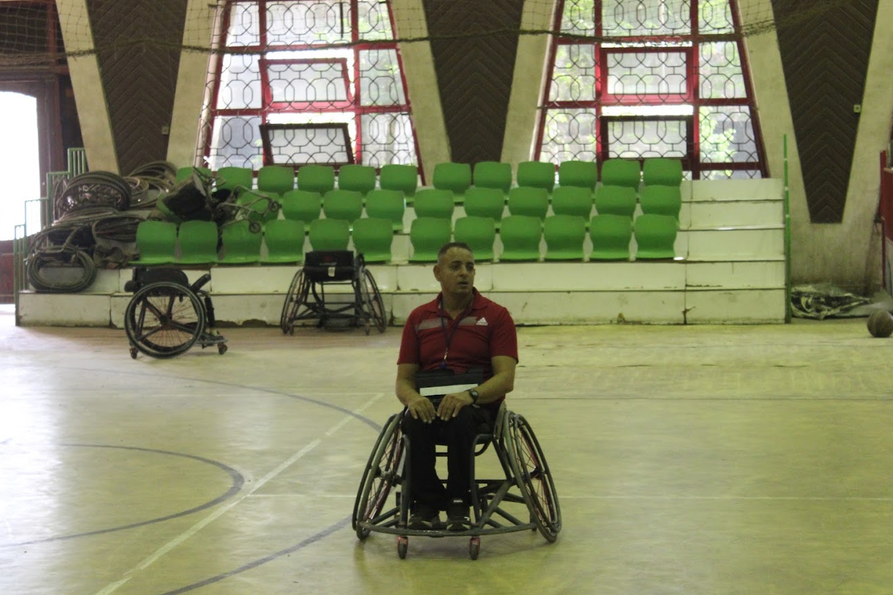
During a break in training, Mohamed Farag proudly watches the young basketball players on the court. He follows their every move, contemplating the possibilities that might open up for them in the future. The young men and women are not part of a team that routinely makes headlines or attracts the attention of fans and investors in Egypt. Yet, for Farag, their potential is worth watching closely.
Seated in their wheelchairs, the players move swiftly across the court at one of Cairo’s sports clubs. They dribble, pass the ball and make their way towards the basket. Farag observes their movements, offers tactical instructions and occasionally blows his whistle.
Now in his 40s, Mohamed Farag, known as Faragello the Stubborn, is one of Egypt’s best-known wheelchair basketball players. With numerous achievements to his name, he continues to play for the national team while managing teams in other para sports. He also devotes much of his time to training young wheelchair basketball players, including those at the Alhassan Foundation for Differently Abled.
Through Farag’s story, the history of wheelchair basketball in Egypt emerges, along with the challenges the sport has faced and the possibilities he sees for its future.
Wheelchair basketball in Egypt dates back to the 1980s, when the first generation of players began practising the sport. Over the years, teams received support from various bodies, including civil associations and government institutions such as the Ministry of Social Solidarity. The first and second generations of players went on to achieve a series of victories, bringing recognition to Egyptian athletes with disabilities.
In January 2022, Egypt’s national wheelchair basketball team won the qualifiers for the Africa Wheelchair Basketball Championship in Addis Ababa, Ethiopia. The result secured the country’s return to the world championship after its last participation in the qualifying rounds in Sydney in 1998. In May 2023, the team won gold at the Arab Wheelchair Basketball Championships in Kuwait.
Both achievements attracted media attention. Television channels interviewed the coaches, including Adel Sherif, and the victorious players, with Farag often taking centre stage. He had also been named best player in several tournaments.
These achievements are all the more striking given the challenges facing the national team. Players describe limited opportunities for development and persistent financial constraints. Wheelchair basketball is an expensive sport, requiring specialised chairs, equipment and access to courts with suitable flooring.
For Farag, however, the challenge extends beyond maintaining a competitive national team. The sport also needs younger players who can carry it forward. A member of the older generation and one of the national team’s most accomplished athletes, he has increasingly turned his attention to nurturing new talent.
Today, he works as head coach and manager of a relatively new wheelchair basketball team at the Alhassan Foundation for Differently Abled, which operates separately from the national team.
Established in 2013 by May Zeid Eldin under the Ministry of Social Solidarity, the foundation launched its Academy for Sports and Arts in 2016, offering a range of activities for people with disabilities. Its work includes creating opportunities for younger participants and encouraging girls to take part in sports. Wheelchair basketball is the academy’s latest addition and operates under Egypt’s Paralympic Committee.
The foundation takes its name from Alhassan Sedky, May Zeid Eldin’s son, who became paraplegic following a car accident in 2011, at the age of 18. His experience prompted his mother to become actively involved in supporting people with disabilities. Alhassan himself has also played a central role in the foundation’s work. Together, mother and son have helped establish infrastructure for the sport, providing equipment and regular training for children and young people.
When the foundation established its wheelchair basketball programme in 2020, May Zeid Eldin and coach Ibrahim Nasr approached Farag to help train the players.
“Having many responsibilities, it took time for me to accept the role. One of the factors was Captain Ibrahim Nasr, who was like a father to me,” Farag recalls.
Nasr was a respected wheelchair basketball coach who trained dozens of Egyptian players and established teams in Kuwait and Saudi Arabia. His influence on Farag was considerable, and his encouragement helped bring the two generations together through the foundation’s programme.
Farag’s experience, reputation and ability to build relationships with players made him a natural choice. To understand what he brings to the young team, however, it is necessary to return to the beginning of his own journey.
The child who discovered sport
Farag’s eyes light up as he watches the young team, boys and girls who have chosen to pursue basketball despite the obstacles they face. Each reminds him of his own beginnings.
“I was just five months old when I got polio. Complications and a medical error led to paraplegia. Despite my parents’ best efforts to reverse my destiny, there was no cure,” he says, recalling the circumstances that shaped his life.
The second of eight children, Farag seemed undeterred by his disability in his early years. In the narrow alleys of his neighbourhood, he often played ball with non-disabled peers, moving around with the help of his arms rather than using a wheelchair. His father, a car mechanic, encouraged him.
As a teenager, Farag came across a television programme featuring Paralympic athletes.
“I experienced a major breakthrough. I discovered that people with paraplegia or quadriplegia could achieve great things in sports. I realised that my disability did not have to stop me from engaging in sport at a professional level.”
His discovery did not immediately excite his father, who worried that professional training would interfere with his son’s education. Farag was 18 and in high school, facing academic pressures of his own.
“My father didn’t want to hear about me dedicating a big part of my time to sports at a club. It was a very tough time in school, so I understand,” he says.
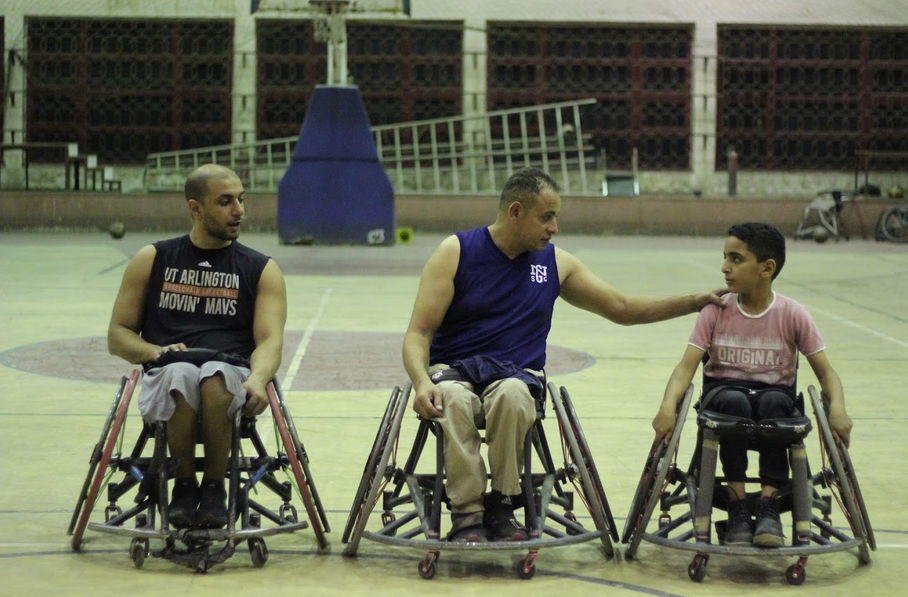
The birth of Faragello the Stubborn
Farag’s determination to prove that he could excel both academically and athletically soon revealed a defining trait: persistence. It was this stubbornness that eventually earned him his nickname, Faragello the Stubborn.
“I started with para powerlifting, then shifted to wheelchair handball, playing with the Embaba team, among others. Handball did not last very long, though. I also tried para athletics, including discus and javelin, and won a couple of gold medals in competitions in Egypt. In 1999, because of my strong arms — a quality I had developed while playing with non-disabled peers — I was invited to join the basketball team.”
Just one year after taking up wheelchair basketball, Farag joined the Egyptian national team, which was coached by Adel Sherif, among others.
His father gradually changed his mind as he saw that sport was not undermining his son’s education.
“My grades in high school were very good. I would wake up before dawn to study, then go to school and training. My father realised that participating in sports had sharpened my focus and strengthened my sense of commitment and responsibility. I continued my studies in the history department at Cairo University, graduating in 2006.”
The walls of the family apartment soon began filling with newspaper clippings and photographs. His father, once concerned about the time Farag devoted to sport, now collected evidence of his son’s growing achievements with pride.
Building opportunities for others
Farag was still a student at Cairo University when he represented Egypt at an Arab tournament in Algeria, where the team won bronze, and at the African Championship in Morocco. The team’s achievements brought recognition from Egyptian officials and drew the attention of senior figures.
During his second year at university, Farag was offered a data-entry job at the South Cairo Electricity Distribution Company, which operates under the Ministry of Electricity and Energy.
It did not take long for him to start thinking about how he could introduce para sports to the company’s employees.
“Often, people with disabilities surrender to their condition. The South Cairo Electricity Distribution Company had several employees who used wheelchairs. Many were overweight and did not take part in sports. It was difficult to establish a basketball team because the wheelchairs were expensive, so I decided to focus on other athletics events,” he says.
Compared with wheelchair basketball, para powerlifting and some athletics disciplines were more affordable, making them easier to introduce with limited resources.
Although many employees initially refused to join, Farag eventually assembled a team of 11. The company agreed to support only eight participants, so the group established a donation fund to cover the costs for the remaining three.
“We used the money to buy standard sports uniforms, including T-shirts bearing the company’s logo, which we wore during the tournaments I organised. I deeply cared about creating a sense of family, an important psychological factor for the team.”
Word of Farag’s efforts soon spread to other companies operating under the Ministry of Electricity and Energy. Over the following years, he built a network of players representing dozens of companies, with teams competing against one another.
At the same time, he recognised the need to develop his skills as a coach. He returned to education, taking courses to strengthen his qualifications and deepen his understanding of the psychological dimensions of sport.
“The game is not just about sport, physical skills and tactics. Psychological factors also contribute to a player’s development. I also took courses in sports psychology,” he says.
In 2015, Farag came up with another idea: establishing a club for the teams he had helped develop.
“I managed to get approval from the Ministry of Electricity and Renewable Energy, and I was offered one feddan of empty land in Shobra, in Cairo. I turned it into a field for para sports. We cleaned it, put up a fence and took care of the grass.”
The space primarily serves para athletics. Farag also encourages the athletes to plant trees and flowers around the grounds, turning the activity into another way of fostering a sense of community and shared responsibility.
While supporting developing athletes, Farag continued playing for the national team. Its more recent appearances included the African Games in Johannesburg in 2020, the Africa Wheelchair Basketball Championship qualifiers in Addis Ababa in 2022, and the Arab Championships in Kuwait in 2023, where Egypt won gold.
One experience from the Addis Ababa tournament remains particularly painful.
“My father passed away while we were playing in Addis Ababa. The team told me I could return to Egypt, but I chose not to. I felt a sense of national responsibility, so I completed the tournament. I received the best player award, among other awards for our players.”
Farag rarely dwells on his individual achievements, preferring to emphasise the collective effort behind every victory.
“Every individual success is the success of the team. Basketball is a collective sport. Each time I shoot the ball into the basket, it is because another player has passed it to me. We work together.”
Hope for the future
Farag’s years with the national basketball team and his work in para athletics represent only part of his contribution to sport. Training young players at the Alhassan Foundation is another important chapter in his career.
Sharing his experience and understanding of the game, he believes the foundation’s energy and commitment could usher in a new era for Egyptian wheelchair basketball.
The death of coach Ibrahim Nasr in 2022 left Farag with sole responsibility for training and managing the foundation’s team. The task is demanding, but the programme has continued to grow.
“We have more than 70 players enrolled at the foundation, boys and girls. The youngest player is 10, and the oldest is in their early 20s,” he says.
Asked to identify the most promising players, Farag hesitates, reluctant to single anyone out.
“Anas, who is 10, is a great talent, a very promising young boy. Mostafa, 12, will be a phenomenon — I can see that! Youssef and Ziad, both 22, have great skills and have already played outside Egypt. We also have many talented girls: Malak, 14, Basma, 14, and Habiba, 16. I really see potential in each and every player.”
His reluctance to favour one player over another echoes his belief that success in basketball depends on collective effort. But his ambitions for the young athletes extend beyond the court.
“I am convinced that this generation will bring about a big change in Egyptian wheelchair basketball. Alhassan Foundation is a very dynamic organisation. It finds resources and cares about making a difference.”
Alhassan Sedky remains closely involved in the programme, despite making the United States his second home. He draws on his connections there to help secure equipment and support the team’s development.
“Alhassan uses his connections in the USA to bring in wheelchairs. He is also strongly involved in training and expanding the network for the benefit of young players,” Farag says.
For a sport that has long struggled with the cost of equipment and limited development opportunities, such support can make a tangible difference. Yet the future will depend on more than resources alone. It will require sustained training, institutional commitment and opportunities for young athletes to continue competing.
Farag has spent decades trying to create those conditions, first for employees at an electricity company, then for athletes across a network of teams, and now for children and young adults at the Alhassan Foundation.
The players he watches today are at the beginning of their own journeys. Whether they will achieve the successes he hopes for remains to be seen. But Farag’s determination to give them the opportunity to try is already part of his legacy.


